Choosing the tool before the problem is how businesses end up with software no one uses.
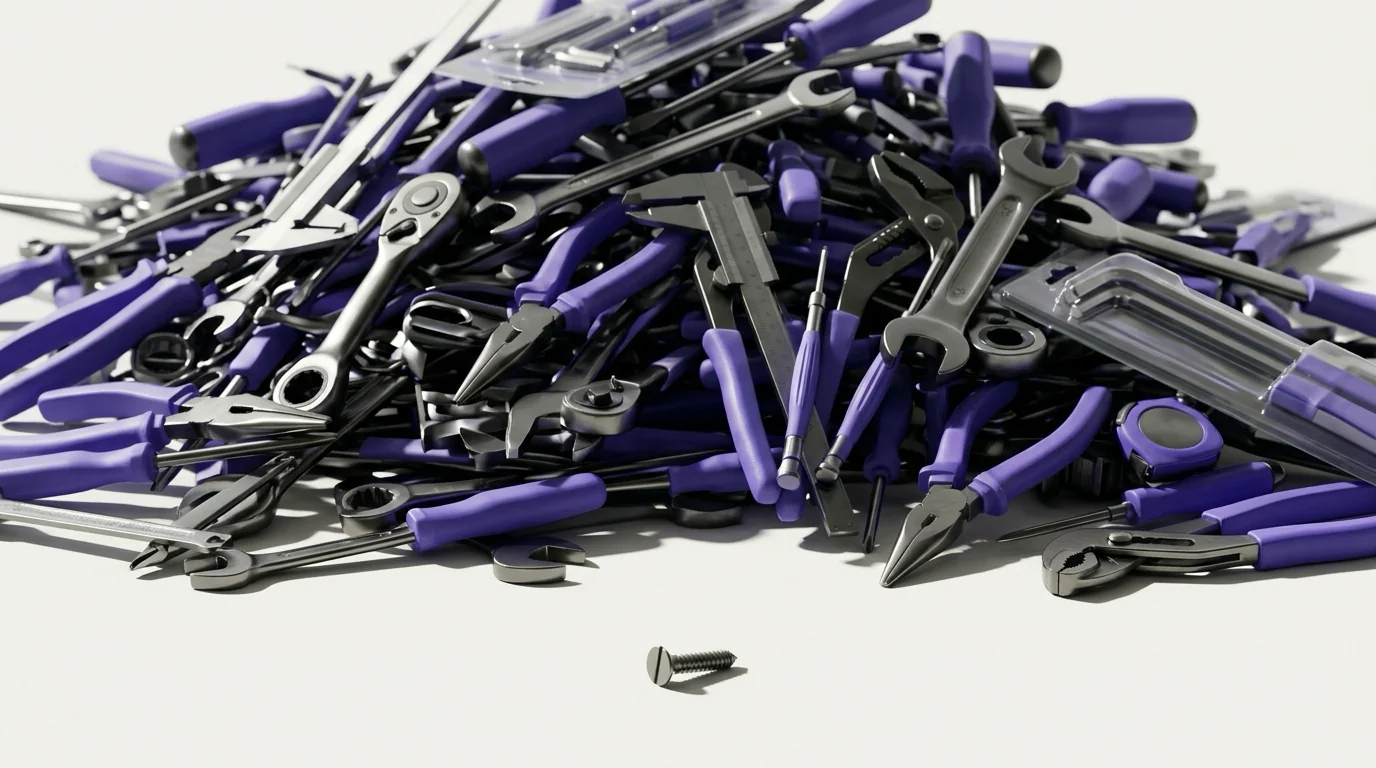
Every time we walk into a company to diagnose its operation, the same thing happens. We open the list of active subscriptions and eight, ten, sometimes fifteen tools show up. CRMs, task managers, automation platforms, analytics dashboards, AI tools bought last year because "we had to start using AI."
We ask which ones are actually working. The answer is almost always the same: two or three. The rest are licenses being paid month after month just in case, or because canceling them would require a decision no one wants to make.
We've seen the same list more times than we can count: a project manager nobody opens, a second CRM nobody finished migrating to, a reporting dashboard that duplicates a spreadsheet the team still uses because it's faster. Each one made sense in the meeting where it got approved. None of them survived contact with how the work actually gets done.
The wrong order
This doesn't happen because owners are careless. It happens because they're making decisions in the wrong order. The common logic is: "we need to be more productive, so we need a productivity tool." The tool gets picked first, then the problem gets bent to fit it.
It shows up in the language before it shows up on the invoice. "We need a tool for that" comes out faster than "here's exactly what's broken." By the time anyone asks what's actually broken, the subscription is already active and somebody's job has quietly become making it look like a good decision.
- The tool got picked in a meeting where no one described the actual problem
- Nobody can say, in one sentence, what decision or task the tool replaces
- The pitch mentioned what competitors use before it mentioned what your team needs
- The team found out the tool existed from an email, not from being asked what they needed
None of those signs are damning on their own. Together, they're a pattern worth noticing before the next renewal.
The right order
The correct logic is the opposite. First, define the problem with precision: what's failing, where exactly, how much time it costs, what information is being lost. Then decide what kind of solution fits: it might be technology, it might be a process change, it might be a hard conversation that was being avoided. Only at the end, once it's clear what's needed, does the tool get picked.
This is slower at the start and faster everywhere else. Most of that slowness is just someone finally writing down what the team already knew but never said out loud.
When the order is right, the tool gets used from day one, because it solves a problem that was already being felt. When the order is wrong, the tool gets abandoned three months later, because it never solved anything specific, it just promised to solve something generic.
A company we worked with was ready to buy a $400-a-month automation platform to "fix" lead follow-up. Two hours of mapping the actual process showed the leads weren't lost to a missing tool, they were lost because no one owned the follow-up after the first call. The fix cost nothing. It just needed someone responsible for the outcome, not for the software.
- What decision or task, specifically, is this replacing?
- Who owns the outcome today, and does that change with the tool?
- What happens if we solve this without buying anything?
- Who on the team actually asked for this, and who didn't?
None of these questions require a consultant. They just require someone willing to ask them out loud before the invoice arrives.
The same applies to AI
The useful question isn't "what AI tool should we buy?" The useful question is "what specific decision or repetitive task in our day-to-day could AI do better than us?" If there's no clear answer to the second, the first doesn't matter.
We see the same pattern with AI, just faster and more expensive. A company adds a chatbot because a competitor has one, not because anyone mapped which conversations were actually costing them time or deals. Six months later the chatbot answers questions nobody was asking, and the questions that mattered are still sitting, unread, in someone's inbox.
The fix isn't more caution about AI specifically. It's the same discipline that applies to any tool: name the task, name who does it today, name what's actually slow about it. If AI is the right answer, that'll be obvious once it's written down. If it isn't, no amount of automation makes the answer clearer.
Frequently asked questions
How do we know if we're about to buy a tool for the wrong reason?
Ask what specific problem it solves before you ask what it costs. If nobody in the room can describe that problem in one sentence without mentioning the tool, you're not ready to buy anything yet. That thirty-second gap between the two questions is usually where the wasted budget starts.
We already have eight tools and only use two. Should we cancel the rest?
Usually yes, but check first whether the two you use are covering the real need or just the easiest one. Canceling six subscriptions without understanding why they failed just clears the way for the next six. Start with the ones you can't explain in one sentence.
Doesn't defining the problem first just slow everything down?
It slows down the purchase, not the fix. Most wasted time goes into building something nobody uses and then unwinding it later. Skipping the definition step doesn't save time, it just moves the cost to a few months from now.
What's the difference between a tool and a process?
A process is the sequence of decisions and steps that get the work done, with or without software. A tool is what executes part of that sequence faster. Buying a tool without a process just automates the guessing, and most companies have more process gaps than tool gaps.
None of this means every purchase needs a six-week audit. It means the order matters: problem first, then the right kind of fix, then the tool, if a tool turns out to be the answer at all.
This is how we work at Linaria: before proposing any tool, we map the process behind it, pin down the decision it has to solve and where it actually breaks, and decide whether it needs technology or just needs order. The tool comes last, not first, and only if it earns its place. If you couldn't say with certainty what your last software purchase actually replaced, let's talk.